Choose your viewer type
Set your role once and we will tailor the guidance across SIP University.
Part L of the Building Regulations in the UK sets out the requirements for the conservation of fuel and power. The exact targets vary by building type and project, but many designers aim for external wall U-values around 0.18 W/m2K for strong performance.
Think of U-value as a simple heat-loss score: lower is better. The goal is compliance without making walls overly thick.
Why this matters to you
Knowing the targets keeps compliance and approvals moving without overbuilding.
What is a U-Value?
A U-value is a measure of heat loss through a building element such as a wall, floor, or roof. It is measured in W/m2K. The lower the U-value, the better the thermal performance.
If you want a simple mental model:
U = 1 / RtotalRtotal = Rsi + (sum of layer resistances) + Rse- Each layer resistance is
thickness (m) / conductivity (W/mK)
SIPs performance (UltraSIPS PIR + 11mm OSB facers)
SIPs can achieve low U-values with less thickness because the insulation is continuous and thermal bridges are easier to control than in stud or masonry systems.
Assuming an UltraSIPS-style build-up with PIR insulation (typical conductivity λ ≈ 0.022 W/mK) and 11mm OSB facers on both sides, the "centre-of-panel" U-values are typically:
- 142mm SIP panel (≈120mm PIR core): ≈0.17–0.18 W/m2K
- 172mm SIP panel (≈150mm PIR core): ≈0.14–0.15 W/m2K
Whole-wall results depend on junction detailing (corners, openings, floors, roofs), fixings, and any timber/structural inserts, so always confirm with a proper calculation for your exact build-up.
Use this chart for early sizing and then confirm with a proper calculation for your exact build-up.
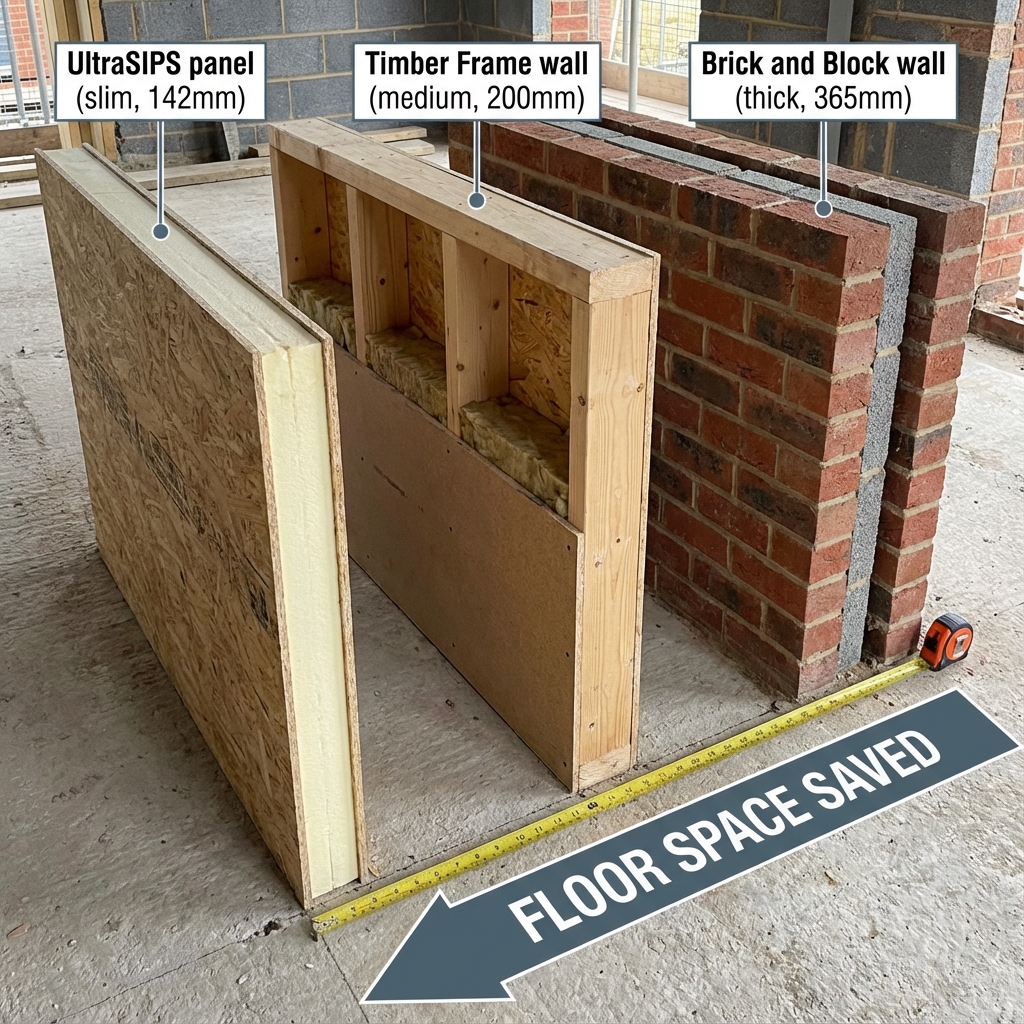
Easy thickness comparison (to match ~0.18 W/m2K)
Target: ~0.18 W/m2K (similar to a 142mm UltraSIPS PIR SIP panel)