Choose your viewer type
Set your role once and we will tailor the guidance across SIP University.
SIPs create a virtually airtight envelope. This is fantastic for energy efficiency, but it requires a rethink of how we ventilate our homes.
Airtightness saves energy, but only if ventilation is planned. Treat the shell and ventilation system as one package.
Why this matters to you
Airtightness saves energy only when ventilation is planned, so this protects comfort and air quality.
The Importance of Airtightness
Drafts are responsible for a significant amount of heat loss in traditional UK homes. By sealing the building envelope, we keep the heat in.
Mechanical Ventilation with Heat Recovery (MVHR)
When a building is very airtight (often less than 3 m3/h/m2 @ 50Pa air permeability), natural ventilation through trickle vents is often insufficient.
MVHR keeps indoor air fresh while recovering heat, so you keep the benefits of the airtight shell.
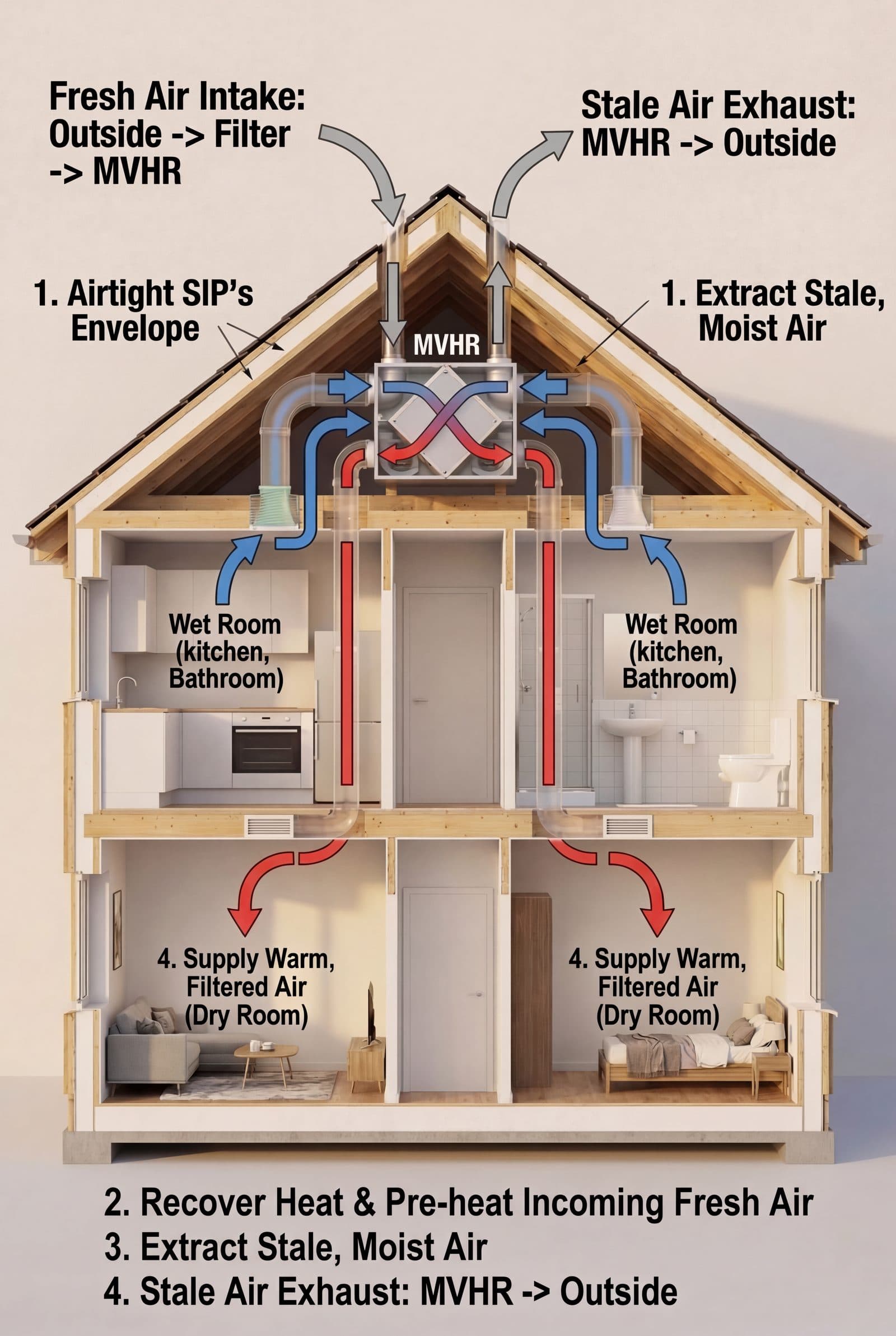
How MVHR works (simple version)
- Extract stale, moist air from "wet" rooms (kitchens, bathrooms).
- Recover heat in the MVHR heat exchanger (the air streams pass heat across a core and do not mix).
- Pre-heat incoming fresh air using the recovered heat.
- Supply warm, filtered air to "dry" rooms (living rooms, bedrooms).
Key terminals
- Fresh air intake: outside -> filter -> MVHR unit.
- Stale air exhaust: MVHR unit -> outside.